Saturday, 7 April 2012
NUC: Caffè Vergnano, Charing Cross

Tuesday, 3 April 2012
NUC: Café Rio, Goodge Street

Monday, 2 April 2012
Worth Noting: the Placard Parade

It's been a year or so since the big March march in London (named the 'March for the Alternative'), in which thousands of people people attempted to show the strength of support against the coalition government's impending programme of cuts and austerity. These people - along with many others elsewhere - were not convinced that the programme would give the promised 'growth,' the 'holy growth,' as it were, that we are told to pray for. And, just as some primitive civilisations would sacrifice humans after a natural disaster, our economic disaster (also deemed to be natural) would be saved by sacrificing the (loosely defined) working class and public ownership in general.
Media coverage was extensive and debates were had concerning reckless behaviour (although, not by politicians, but by protesters) (and not by police, but by protesters). The days pass and the media lose interest. The bills pass and one is left questioning why we bother marching. Protesting is, as is often said, one of the precious 'rights' that we have in this liberal democracy of ours. Such people who say this usually follow it up with 'but with these rights of freedom, come responsibility.' Responsibility to ensure that the actions we take don't actually go as far as to actually be threatening. It is indeed our right to protest, under certain conditions at certain times, through certain routes with certain clothes. 'This way, you can protest, we can ignore it, and everyone's happy.' Life goes on, and events like this become mere memories.
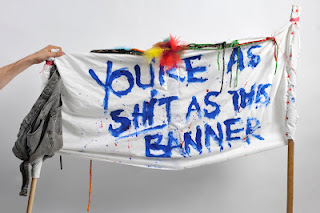
Some students from Goldsmiths College collected as many placards from the day as they could. This became the Save Our Placards projects, and plays with the physicality of these potentially political objects. The name itself is a slogan imitative of those that appear on placards. Perhaps it is an attempt to possess some kind of authority over the way we collectively remember these events, or to address some kind of problem concerning the conventional cataloguing of such memories in a supposedly neutral discourse.
The media tend to forget things once the initial rabble-rousing has sold enough papers, or gathered enough viewing figures. With this decline in their interest comes a sort of acknowledgement that the matter is now less important, that it doesn't need to be addressed. Thus, Syria matters; Bahrain less so. And a few days after the top flight of the Conservative party comes into question concerning its dealings with big ugly money, contextualising the recent budget, the agenda changes to focus on a more tasty story about pasties and the upper classes. Apparently even pasty scandals can't bring our government into disrepute. Our attentions and passions seem to be so carefully manipulated, and its the same with the legacies of things like protests - their significance, meaning, ownership.
The Placard Parade challenges this media tendency, but also works through it by producing a media-interest event, in producing a spectacle which is politically attractive to sympathetic publications (the Guardian) and is playfully provocative. It invites a slightly confused involvement. We set off in small groups - I was with two others - along the South Bank, over Blackfriars Bridge, along Victoria Embankment, back across the Hungerford Bridge. The small group was somehow remarkable, somehow amusing. It intermittently punctured the normative landscape, unsettling it with signs (in the literal and linguistic senses) that cause alarm: Politically-motivated individuals are upon us, they're dangerous and/or annoying! They should get off their high horses. So how would these hippies run the country? What gives them the right to tell me to 'wake up'? Why don't they get a job and get on with it? There will soon be riots. Where are the police? (Read the patronising reflection of last March's protest by Conservative MEP Daniel Hannan for an example of this type of reaction).
But without the usual strength-in-numbers we were somewhat pathetic, apparently having lost our comrades, now outnumbered and swamped by tourists, families, people enjoying the sun, people running for trains... The publicity of a huge march gives people a clear-cut choice to either be in it or not, to be involved or detached, to be in the kettle or watching the news while the kettle boils. But these lines of division are today averted, we are amongst an unremarkable cross-section of society, not channelled down a prescribed route by the police. They find us confusing; we find us confusing. What is this - A protest? A homage? A vigil of sorts? Are we keeping the fight going or accepting defeat? 'What are the cuts'? 'What's happening to the NHS?' Indeed, perhaps nobody really knows.
We're invited to question the protest, the established modes of going about it which are tried, true, and harmless. The slogans we pick and their supposed force or arbitrariness - it seems we might as well chant whatever comes to mind. Is it our lack of conviction in an alternative or an inability to gain a distinctive voice within political discourse which makes our demands seem hollow?
On another level, something else is at stake. The placard parade's critique of the institutional recollection of events extends into a critique of the management of the events themselves. Save Our Placards seeks to situate the anti-cuts discourse into areas in which it sits uncomfortably. The parade presents itself as 'not quite a protest' but is yet not innocent. As such, a route was indeed agreed, along with a time and a warning by the police not to widely advertise the event.
Save Our Placards have also approached other institutions. At the Turner Contemporary, a commemorative exhibition was to be shown in the Nothing In the World But Youth. However, at the last minute the exhibition was cancelled. Having made the agreement with the gallery long before, one might understandably wonder why the plug was pulled and put down to a rather tedious health and safety excuse.
The project continues, and it's managed to get into a different exhibition in Cornwall. It serves to question the documentation of anti-government projects, the political and economic alliances between institutions and the tactics used by protesters themselves. Ultimately, I think it continues to invite us to imagine new methods of protest for an age in which the lines of division are more complex than was previously assumed.
Check out Save Our Placards: http://www.saveourplacards.blogspot.co.uk/
Monday, 26 March 2012
NUC: London Particular, New Cross

Have I not written about this place before? Apparently not. I travelled here dragging a big book to read, but finding myself compelled to muse on this café instead. Last year I'd come here a lot. It's small, with one table filling the room and a couple of shelf-tables on one side, with stools. Capacity is limited and before long you're sharing space with some other hapless flaneur, reading a paper or waiting for an associate or two. The table juggles us: those in groups move to the more spacious spaces; the solitary individuals fill in the gaps. Today I am the latter.
Occasionally, conventions crumble and we lapse into conversation. Once, I was sitting at the end, by the window, and a decorative classical guitar. Despite the café being at street level, there is a stark drop out the back, and I feared for the life of the man cleaning the windows, balancing on the ledge outside. Bad things don't happen if you aren't watching, I told myself, and continued to read. On this day I met Carol, from Bermuda. I must look trustworthy because she asked me to keep an eye on her phone, which was plugged into a wall, while she disappeared for a few minutes. Keep an eye on it for what purpose? So it doesn't gets stolen. Stolen by whom? A stranger. And, what am I if not a stranger? The chance to liberate an expensive phone from a preoccupied Bermudan had at last arrived. Was I to take it? I glanced towards the door. Only a busy barista was there, rearranging pastries. Behind me, the window cleaner regained his balance and kept cleaning. My coffee was half full, as they say. I envisioned the imminent dart out the door, yanking the phone from the socket en route, laughing hysterically as I ran down the centre of the road with my prize. Perhaps I'd steal a car while I'm in the mood, and flee the country.
The Bermudan was back. She thanked me for watching her phone and took a seat on the table. Just the two of us here, overlooked by the secondary characters, the barista and window-cleaner. She introduced herself as Carol. During our conversation it materialised that she was drawing me. The brief subjection to a photograph is unnerving to me, so imagine what being drawn was like. At least it's not as accurate as a photo; that's its redeeming quality. Sadly I know no way to get in touch with Carol now.
Today, prospects of negotiating a conversation with another human seem slight. The day just doesn't seem to hold that promise. Air's second album is on. It holds memories about which I am uncertain - memories yet to become classified, but are aroused by this album like a scent transports you to a forgotten past.
Like I say, last year I came here a lot. Less so now. Maybe I'm too busy or too poor. It's £1.80 for a 'long black'. I think the coffee may have got slightly worse, or perhaps my standards have raised. Or maybe it's an off-day. I still find it a place well worthy of my time though. And the effect on the brain of this not-bad coffee, combined with the pressure of the day - which I put down to the weather and the unmanageable things in life which require endless lists, ordering and reordering, before inevitably refusing to be sorted anyway - is still, I must say, pretty remarkable.
The staff chatter and clatter their pots. The atmosphere in here is nearly at bursting point. I think if someone said something to me - 'can you pass the sugar' - the moment would be so profound, so at odds with this strange dream, it would throw me from this circulating inner conversation I am having with myself, throw me back into something like reality, and I'd break right down.
Thursday, 22 March 2012
NUC: Gallery Café, Bethnal Green

Monday, 12 March 2012
Collection of Reviews

Notes from a café in a hydraulics factory in Wapping: http://canarymagazine.co.uk/dir/portfolio/notes-from-a-cafe-coffee-and-immaterial-production-at-the-wapping-project/
Friday, 9 March 2012
NUC: Notes, Charing Cross

Notes from Notes, the music-themed café in Charing Cross. To the left is a long bar stretching back, back, to a door which leads below where you can buy music or go to the toilet. Behind the bar smartly dressed people smile and take orders in a slightly conveyor belt-esque manner, and charge quite substantial prices for their drinks, discouraging the unemployed. Wine and olive oil are set amongst the glittering decor. At the back of the room is a space, with long tables and solitary people with laptops or newspapers. CDs on racks peer down on these folks, and are for sale - go below for that. Amongst them, a TV plays Woody Allen's Purple Rose of Cairo, which funnily enough I have only just seen quite recently. I tell this inconsequential fact to Niina, with whom I am coffeeing today; she responds with appropriate indifference.
She sits there examining her hair in the mirror, one of those mirrors that spans the wall and makes the room twice as big, and her hair twice as big. We discuss all things Finnish, and the irritations of city life. The coffee is strong and I wish I had had milk. I already had one coffee earlier and the amount of caffeine in my bloodstream is reaching tipping point. This place is one of those that strives to personalise itself and choose its clientele. The mid-thirties executive with the afternoon off, perhaps, who switches between Radio 3 and Radio 4 as he prepares his Weetabix, but can't name any of the composers and feels ambiguous about Europe. "Well obviously it's good that we didn't go in for the Euro... Having said that, I do enjoy a weekend away in Venice."
Notes is a music café, but it seems to be more of a theme than a passion. Like, it's more geared up for those who would like the idea of a music-themed café, as a kind of oasis within an emotionally cold city, rather than those who would go to a café for the music it played. How patronising of me. Notes is certainly nice, I can't say otherwise, it is peaceful. Maybe today is not the day for peace, though? Another judgement is needed, I feel, and so I will save up especially and return. In the meantime, can someone tell me which café really plays excellent music? One that really goes out of its way for it? And if it doesn't exist, can someone open it? Potential names could include: Coffee Beats, Puccini's Panini, Caféphonics, The Rolling Scones, The House of House, Gabbaguette, Café Grindcore, and Grubstep.