Thursday, 20 October 2011

"Occupy!" The Broadway show comes to the UK.


Summer comes to an end, pitifully hanging on in that first week of October, and with it, all my theatre dates. But no, one show remains. Only recently announced, with free tickets and no need to book, the much talked about, - infamous, even - Occupy! has come to London.


With big names on the bill at Occupy Wall Street, such as Slavoj Zizek, Naomi Klein, and Joseph Stiglitz - and Michael Moore giving an early review of the show - hopes for further successes are high as Occupy! goes global. Indeed, sharing credit with the ongoing Indignants, which debuted in Spain in May, the influence has now spread to 951 cities in 82 countries. It's a sell-out show, with plenty more tickets. On Saturday 15th October, the curtain at London was raised...


I came in during act 1, and the cast were caught in a solemn moment of hesitance. The police had blocked all entry to Paternoster Square, where the London Stock Exchange is based - a tellingly private piece of London land, owned by Mitsubishi. A disappointment clung to the air, I sensed, as those turned away from the Stock Exchange found refuge on the steps of St. Paul's, and police predictably surrounded them, intimidating those outside who might like to go in.


As we circled the epicenter, drifting down the various streets nearby until coming up against another police blockade, we were treated to a few musical numbers. "Who's street? Our Street!" is a sing-along classic, and was beautifully choreographed under the St. Paul's backdrop. A curious juxtaposition was exercised between the cast's harmonies and the cold "MOVE BACK!" authoritatively commanded by those with batons and pale blue hats.

Back at the front, where the mood had lulled, emotionless characters stood side by side, looking over the police line to the central cast, looking in hope for some kind of sign. Act one was taking an unusual route - anger had subsided, territories had been established, no one really knew what to do. Would the media take notice if the day lacks violence? What will have the bigger legacy - the London riots or Occupy London? Occasionally, a slow spiraling bellow would circulate amongst the crowd, expanding and then dying out. Something was needed to keep the audience's attention - if not a media frenzy, then perhaps understanding, solidarity and optimism.


Another curious contradiction was explored through the inside/outside opposition that ran along the police line. Those outside, as I was, were free, whereas those inside were trapped. Not simply because of the police - at this time people could go in an out from either side, providing they go through the correct checkpoints. No, what I mean is, those outside were freer agents of expression and choice. Take the two photos above, for example. The one on top, from outside the central zone, a fabric hung on an HSBC bank. No police surrounding this bank, they're all surrounding the Stock Exchange and those in front of St. Paul's. Whereas, in the photo underneath, from inside the zone, a queue outside Starbucks of post-Soviet Union proportions. This is more than just a clever use of irony. Here we at once exploring the cliché of those who attend such events - middle-class Foucault-reading coffee-drinkers, whilst highlighting the increasing practical dependency we have on the capitalist institution, combined with a growing sense of capitalist realism, as Mark Fisher would put it. Are we saying, "Capitalism's here to stay, so let's tolerate Starbucks (and with that, McDonald's, Coke, Nike, Philip Green, Vodafone, etc.) and only focus on finance"...?
It's not an easy one to call, that one. But this seemingly lack of political coherence is perhaps one of the strong points of the show. Answers are not simple. Only politicians think they are: raise university fees = more money, so goes government logic. Ideas, demands, projections, alternatives, all are complex. A coherent non-capitalist alternative is not likely to be presented by the end of this day. Just because Occupy! doesn't have an "...ism" doesn't mean it is to be ignored. That which unites is simply growing inequality and unfairness, and that which it revolves around is an economy which relies on, is indeed blackmailed by, a global financial discourse which sustains said inequality and unfairness.


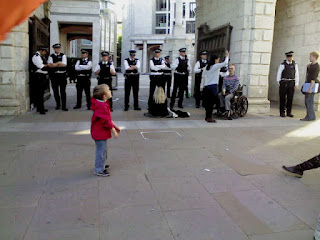
Act 2 began, we passed through the checkpoint, into the zone. I had not realised that this was not only immersive but participatory theatre. The sun beat down and people relaxed, erected tents, meditated, read books, yelled slogans. Time for another song - "This is what democracy looks like!" I'm less keen on that one. Good tune, but I'm uncomfortable with the message. Where's our target? Have we moved on now from capitalism, through finance, to democracy? Indeed, this is what Western democracy looks like - to protest under specific constraints, and then pop off to Starbucks for a FrappaZappa and to use their crapper. Occasionally one character will be centre stage, lost in a rambling soliloquy, maintaining that the camp is an example of how to live outside capitalism; that this, dear friends, is the model for our new economic order. It's hardly a Badiouian event. Hold on, the Zeitgeist movement are prowling, recruiting, with their conspiracy theories and 'resource economy' alternatives. This is a place of many voices, I see, some more idiotic than others, but all important ingredients. It's like fish sauce - terrible on its own, but brilliant when almost completely drowned out by other things.

Indeed, globally, the power of this outcry lies in that rhizomatic lack of centre, whilst attacking a very specific centre, ultimately - Wall Street - the financial centre of the world; from which another sinister web takes leave - the global exchange of capital. All the Occupy!s, wherever in the world, also occupy Wall Street, with those who are physically there. Not just 'in solidarity', but through the airwaves in which capital flows, through that which connects all financial centres in all capitalist countries. It is no more than a node in a global network that is growing, and applying pressure to a gradually crippling system. We need not be disheartened if the show lacks coherence at the moment, or if it lacks an answer to the problem, for it is still in the making - you don't throw a pie before it's baked.


After an intermission we returned. The lights had gone down and it was cooler. A wheelbarrow of sorts appeared behind me, pushed by a girl. She bore gifts of ciabattas and fruit for the hungry characters within. It was a struggle to get them past the bemused police officers. "Why do you want to go in there," came the question. Rhetorical, of course. The first night of a projected many was at hand, and those on the front line need more stuff - tables, blankets, food, but mostly, people. At present, Occupy! is a performance that shows promise, that could become something special if it continues to run. But it could equally wane as the winter deepens and people stay indoors instead of going to the theatre. For now, what's needed is some more dynamism - not too much so to as exclude the nice people, but enough to draw in the audience. Carefully choreographed scenes of strategic intervention: bank sit-ins, rowdy day-trips around the city, reputable speakers, street parties, general civil disobedience.

NUC: The Poetry Place - Covent Garden


Went straight past the door of this café, Chris clawed me back. It's a fine place to be on a warm afternoon. Other people are scarce here: a woman peers into a laptop, scribbling notes occasionally; a balding gent reads a book; the barista is planted by a table to one side, reading, pained to arise to serve us. Poetry books line the shelves; poets in picture frames line the walls. Something tells me this particular café leans towards the poetic. Indeed, The Poetry Society are behind this outlet, I'm dutifully informed. A couple of voices resonate from below, the basement, where performances take place. Someone is planning, planning poetry.

What a quiet place. Chris and I, low tones and civilised conversation, puncturing the calm with our witty remarks. A stereo plays from somewhere, songs which sound like sentimental advert songs. You know the type - life is good, I have a ukulele, let's all sing and dance and start a mobile phone contract... It's not bad though, musicwise - I rushed to cynical judgement. The lampshades are like translucent pieces of paper hanging from wires, with scrawled writing across them. The Poetry Place plays with the rustic look, wooden tables, wooden floor boards, but selectively modern. It's not cheap. And I've had better mochas. But mochas are a tricky beast, everyone knows this.

Real nice. Good for afternoon reading / working / composing poems. Just need to become a poet.

Sunday, 9 October 2011

Notes from Underground Cafés


What is a coffee shop? What is a café? It's a problem that many have grappled with. In The Republic, Thrasymachus demands that a café is simply a place to have a coffee. Socrates replies, "But Thrasymachus, you are a sensible man, are you not? Why do you not have coffee in your home?" Thrasymachus says that indeed he does have coffee, but sometimes he prefers to go out for one instead. "So you go out simply for a coffee, as you would put it, instead of staying at home, where you already have coffee and a slave to make it for you. We all know that the coffee in the café is vastly more expensive. Is this a good way to spend your money, Thrasymachus?"


"It is worth the extra," says Thrasymachus.

"And what would you say makes the extra worth that is being added to the value of the simple coffee?" says Socrates.

"To be out of one's home, to be amongst the people of the city as they come and go and stop and read and talk, to smell the coffee brewing, and the baguettes, paninis and bagels."

"But, my dear man, did you not say that the café is a place to simply have a coffee, and nothing more?"

"Or a panini, or a bagel,"

"It sounds like there is yet more to it than that, am I wrong?"

"No, perhaps you are not wrong, Socrates," conceded Thrasymachus.


And Socrates went forth to try to further understand what it is that makes a coffee in a coffee establishment different from a coffee at home.


But let's leave the room where the Greeks do their chatter, and find out for ourselves, yes? In London's many coffee shops we will go, with notes aplenty to recount. What of the staff, the furniture, the music, the lighting, the pictures that line the walls, the quality if the coffee, the garden, the clientele? What makes this place what it is? And is it any good?


Note: despite the illusory sensation that Starbucks, Costa, Pret a Manger, Nero, etc., are indeed coffee shops, they will not be included here. There are various reasons. 1. Due to the corporate structure, the staff are the same as staff in supermarkets or Macdonalds, which makes the labour experience in one of these shops one of undifferentiated corporate submission, rendering the staff little more than smiling robots, and empties the coffee itself from its coffeeness, making it somewhat a burger or a loaf of bread. 2. 'Experience' is handed down as a necessary business strategy, a gimmick, thereby precluding reality in this particular space. I'm not talking about authenticity here, but formulas. 3. The formula means that the same thing will be found in Idaho, Brighton, and Moscow, and has a fundamentally detrimental effect on local idiosyncrasies, whilst simultaneously promoting an ideology of prescribed sameness. 4. The economic factors that go with that previous point, as well as the labour problems that come with having a global work force, including union rights and coffee farmers. 5. The 'save a coffee farmer's child by buying a coffee' rubbish that makes you think you're saving the world by shopping at Starbucks instead of making it worse. 6. The idea is to experience the diversity, not the uniformity, of London's cafes, and to do so before they have all become franchised replicas of one another.


To the coffee!

Thursday, 15 September 2011

from the street - a week with freddie


this week it was my turn to look after freddie. freddie is our frog. sometimes he jumps out of my hand but he never goes far because i think he likes me because i give him food. he has big eyes. today we went to the park. i put freddie on a log and i think it was like home for him. but there was less water. frogs like water. sometimes when i watch tv freddie makes a noise. i dont think he likes the adverts. i say i dont like them too but the actors need to rest. freddie does not like chocolate. even kit kats. but that is ok because im only allowed one kit kat so i dont like sharing it. the other day me and freddie played soldiers. i was England and freddie was Germany. freddie also had the micro machines but England still won because i have better aim. i wish freddie was bigger so we could play football. he could go in goal and i could practice penalties. tomorrow freddie goes home. i have had a nice week with freddie and i think he liked me more than the others because sometimes i put him in the sink and fill it up a bit.

Friday, 26 August 2011

3rd Week on the Fringe

The riots subsided, and banality came back to the lives of us all. Phew, we thought. Back to the nine to fives, the weekly shops, the Libya conflict and the Murdoch affair. And back to Camden for more shows. On Monday I went to a play, or two plays in one, which was at 4:30 in the afternoon. Are you serious? Who's going to go to the theatre at 4:30 in the afternoon? Well actually a great many people, thanks to rising unemployment, perhaps.


So begins Frozen Moment, KU MA Showcase of New Work. That's a title that gets straight to the point, right. We had two plays, a lightly humorous school-based play and a heavy and dramatic domestic play. Review here. I left the theatre a bit dazed and went to Sainsbury's, as you do. "We apologise for delays at the checkout due to a high volume of customers. Thank you for shopping at Sainsbury's." Great. Didn't matter, I was still trying to work out what had happened in that play.


I had two days off, which I mostly spent reading Percy Bysshe Shelley's The Cenci and Derrida's essay on Artaud, and watching Curb Your Enthusiasm. All research for Thursday's show, Beings, a butoh dance. Hands down, most outrageously different show on the Fringe. The five audience members sat there gawping at this curious performance, review here. Nice people too, this butoh company. They talked to us for as long as they could. Went to a metal bar with Bella after that, and just about caught the last tube home.


The last show show of the week was more geek-comedy. Met Alex en route to the Theatre by chance, and happily abandoned her in the pub when the time came for the show. Needless to say, geeks are not for everyone. Rob Deb was an excellent geek though, review here. A pretty funny guy, self-deprecating as one must be when your past-times involve staring at a screen updating your collection of potions, and preparing to battle some wizard.


Got out of Camden early that night, back to the Marquis for Cinthya's leaving party. Before long though, Dave was puking in a bush and they both had to go. We weren't far behind. Went home, intended to go to a party but the enthusiasm slowly wained as the sofas became more confortable. Plenty of music though, and Adventure Time. In case you're wondering, Albert never showed up.


One more Fringe week remains.

Saturday, 20 August 2011

Bel Ami: The Musical. White Bear theatre, Kennington. 28-July


The Nineteenth century's Parisian Belle Époque seen through the eyes of Guy de Maupassant, the author of the novel Bel Ami, has a dark side. Political scandals, debauchery, back-stabbing, and the odd token accordion. 'Blessed are the crafty,' as they say.


Appropriately enough, the theatre in the White Bear is the back room of the pub, so a certain inherent seediness is already present. We're led to our seats through a Parisian café-bar, our opening scene, the cast frozen as still as the furniture holding cigarettes and small French beers.


Into this world steps poor Georges Duroy, a man struggling to find his place in an intimidating Paris. With encouragement from a growing number of friends, all he can do is embrace this malicious bourgeoisie, and ride this wave of decadence to the top of society.


This tale of assent is carried with song, an array of compositions to meet every mood expressed, and a moustachioed waiter looking on with a wry grin, occasionally compelled to contribute the odd saxophone solo. From burlesque and back-room romps, to heartbreak and fear of death, the songs convey more than the dialogue, upon which the narrative merely floats. At each turn, Georges exploits the situation for his own ends, befriending powerful women whilst remaining childishly innocent and, without the story really forcing him, he nevertheless becomes more wicked as time goes on.


As a result, our hero can be slightly hard to understand, as are our seductive selection of Parisian beauties who all fall for him but remain equally scheming. It is the elderly characters, despairing over heartbreak and getting old, putting the trivialities of life into perspective, that relate to the audience the most.


Above all, however, this is an opportunity to indulge in the romantic past of a city bursting with character, to embrace a particular mood conveyed with elegant songs and absorbing choreography. Bel Ami - The Musical leaves aside more serious reflections into a society preoccupied with power, gossip and success, in favour of an overall atmosphere and an abundance of style.

Tuesday, 16 August 2011

Reflections on a 2nd week reviewing the Camden Fringe

There's not been much to talk about this week that hasn't involved 'wanton thuggish violence', the disorder of a feckless sick portion of our otherwise squeaky clean society. Yup, war reigns, bankers bank, Murdoch's still alive, Cameron's at the helm, energy prices rise, so do train fares. The bloody unemployed! They cause us such trouble.

Which reminds, I'm working for free, no income whatsoever, reviewing theatre. I'm am also a sponger, planning on pushing out a kid to double my benefits. Playin' the system, yeah that's me.

All that aside though, to be away from the 24hr rolling news, watching inflammatory rhetoric spill into my room, was needed this past week. The theatre, ladies and gentlemen, was the place to be. Of course I couldn't go if I didn't get free tickets.

Alas, I only had shows on Monday and Sunday. Monday, last Monday, the 8th: I got housemate-James on board and we went Central way. James had a mocha for the first time, 'twas a day packed with adventures like that. Walked from Oxford Street up up through Regents Park, big park, to Chalk Farm. Had some great chips in Chalk Farm and went to the Roundhouse to watch Stand-Up Comics. Review here. Marianne and, eventually, Alex, joined us. Pretty enjoyable show - sitcom through and through.

Went to the pub afterwards, where the news was on. And shit, things had kicked off. If you recall Monday night was the night of London's youth terrorise the communities aaaahh. Watched that over a couple of beers, excellent TV. Then headed home and watched it for most of the night on TV. Compelling television, these guys must have been behind it... They're so good at television. The aforementioned Chalk Farm soon enough had become a bomb-site war-zone. Pretty quiet in Brockley, all in all. Only the foxes roamed the streets, and the locals were reading Dickens by candlelight.

So uh, didn't do much theatre-wise until the next Sunday. On, I think it was, Thursday I worked out how to get my laptop to 'wake up' and automatically start playing Radio 4. This was one of many life-changing experiences of the past week. That and the home-cooked chips I made.

Oh, Thursday night. Pub crawl with the housedwellers. Fine times in Brockley, half a pint in each pub bound towards New Cross. Painted the town red, although it was already pretty red after the riots anyway. An extra coat is all we contributed.

On the way home I bust into a Sports Direct and nicked a ping-pong ball.

On Sunday Chris and I saw two plays. Princess, review here; and the First Supper, review .... .... .. here. Both were pretty good. Princess, heavy, intriguing, true story about a girl waiting for her husband-to-be to return after jilting her. Good use of sound. And The First Supper, really funny. Silly sketches, frozen peas.

And that was it. Two more weeks to go. Or as they say in French - deux more weeks to go.

Allons-y.